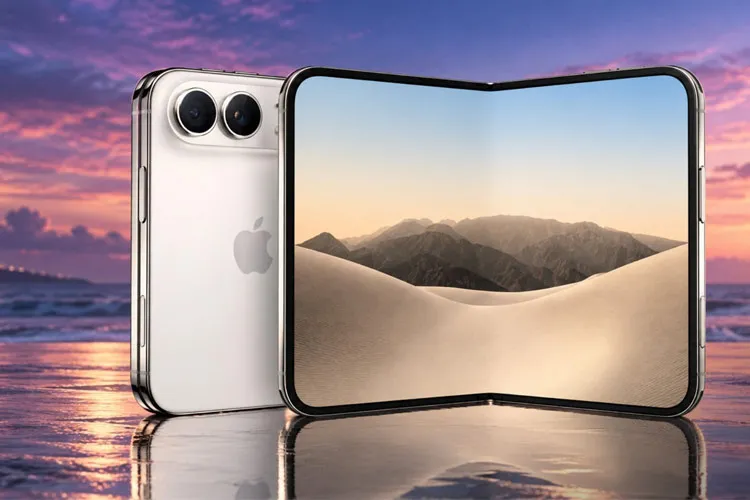
Apple's first foldable phone, named the iPhone Duo, was introduced with a 7.6-inch inner display, a 5.4-inch outer display, and the same A20 Pro chip used in the iPhone 18 Pro. However, a close look at the technical specifications shows that to achieve this foldable design, Apple had to forgo some camera features, authentication methods, and professional photography tools; in other words, the Duo should not be considered the foldable version of the iPhone Pro, but a product with a different design philosophy.
1. A camera with shorter zoom reach
The iPhone Duo is equipped with a dual-camera system consisting of a 48-megapixel Fusion main camera and a 48-megapixel ultra-wide camera, and its maximum optical zoom reaches two times.
In contrast, the iPhone 18 Pro, by employing a 48-megapixel Fusion telephoto camera, offers optical zoom up to eight times and optical zoom up to sixteen times.
2. Removal of variable aperture
Apple added a four-step variable aperture (with values ƒ/1.48, ƒ/1.8, ƒ/2.8 and ƒ/4) to the main camera in the iPhone 18 Pro to provide finer control over incoming light and depth of field. Meanwhile, the Duo’s main camera is offered only with a fixed ƒ/1.6 aperture.
3. Lack of professional control tools
The Pro Controls suite, which allows manual adjustment of aperture, shutter speed and white balance along with an exposure histogram, is not listed in the iPhone Duo camera specifications.
4. No support for ProRAW format
In addition to HEIF and JPEG formats, the iPhone 18 Pro also supports ProRAW, giving photographers more flexibility in editing images. Apple has stated that images captured with the Duo will only be saved in HEIF and JPEG formats.
5. Removal of ProRes and ProRes RAW formats
In the field of professional video recording, the iPhone 18 Pro supports ProRes and ProRes RAW formats, but the range of video recording formats on the Duo is limited to HEVC and H.264.
6. No spatial photography capability
The Spatial photography feature available on the iPhone 18 Pro is not mentioned in the Duo’s official specifications; nonetheless, this foldable phone still offers a wide range of photography and videography features to users.
7. Absence of Apple Reference Image feature
The Apple Reference Image tool embedded in the camera section of the iPhone 18 Pro is not present in the Duo’s official list of camera features.
8. Replacing Face ID with Touch ID
For the Duo, Apple uses a Touch ID fingerprint sensor embedded in the side button instead of the Face ID system; whereas the iPhone 18 Pro still relies on Face ID for unlocking, payments, and in-app authentication.
9. Removal of the LiDAR scanner
The LiDAR scanner, which is one of the sensors of the iPhone 18 Pro, is not listed among the Duo’s official sensors - which include Touch ID, barometer, gyroscope, accelerometer, proximity sensor and ambient light sensor.
10. No Action Button
The Duo’s button design includes volume keys, a side button and a camera control button, but Apple has omitted the Action Button from this set; while the iPhone 18 Pro, in addition to the camera control button, also features the Action Button.
Compromises for a new experience
These differences do not mean the Duo is categorically inferior to the iPhone 18 Pro. Apple equipped this foldable phone with the same A20 Pro chip, an advanced cooling system, and two displays with ProMotion technology supporting refresh rates up to 120 Hz. The phone’s multitasking capability also allows running two apps side by side on the inner display.
It seems Apple’s strategy is clear: the foldable phone focuses on a large display, multitasking and innovative design, while the iPhone 18 Pro remains the flagship for professional photography, advanced camera tools and specialized sensors.
Another notable point is that the Duo’s base price in the U.S. market is set at $1,999, while the iPhone 18 Pro is offered with a base price of $1,199.