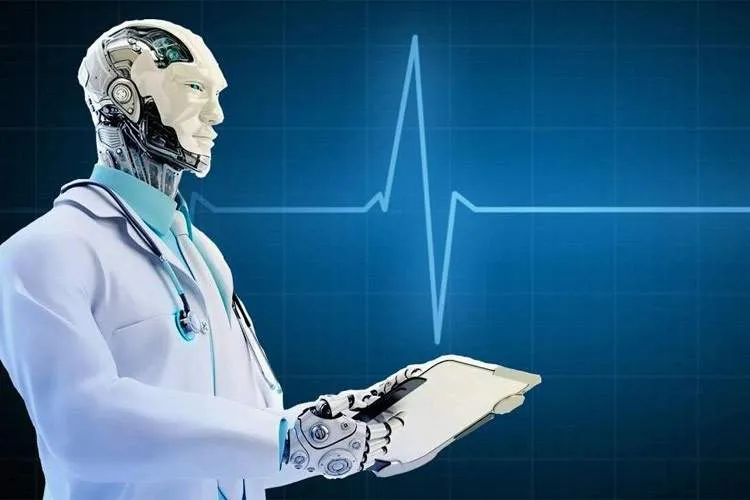
The chief executive of Britain’s largest technology company said advances in artificial intelligence over the coming decades will lead to finding a cure for cancer.
Rene Haas, chief executive of Arm Holdings, one of the world’s leading chip designers, claimed that artificial intelligence will be able to solve the problem of modelling the DNA markers that cancer affects; a problem that is currently “too complex” for humans or present AI systems.
Arm, headquartered in Cambridge, designs semiconductor architectures used in billions of smartphones, smartwatches and other devices worldwide and has an increasing share in AI chips used in data centres.
The company has become one of the biggest beneficiaries of the global AI boom and earlier this year became the most valuable British company in history with a market value of over $400 billion.
Haas told the BBC: “AI is going to… find a cure for cancer that you and I and other humans today [cannot] find in our lifetimes. I believe that in our lifetime, AI will help cure cancer.”
“Modelling a cell, modelling a human, modelling how cancer affects a DNA marker is a problem that is too complex, not just for today’s humans, but for the computers that run AI.”
“However, in the future, the more models we put into those computers and the more advanced the computers become to run those models, they will solve this problem.”
Recent advances in AI in the health sector have increased optimism about the technology’s capacity to accelerate medical research.
In 2024, Google DeepMind unveiled AlphaFold 3, an AI model capable of predicting how proteins, DNA, RNA and drug molecules interact.
This long-standing challenge in biology was an important milestone on the path to discovering and developing drugs for treatments that can transform patients’ lives.
Earlier this year, Isomorphic Labs, the spin-off and subsidiary of DeepMind, began preparing the first human clinical trials of drugs designed by the company’s AI systems.
Other pharmaceutical companies such as AstraZeneca, Eli Lilly and Sanofi have also signed multi-billion dollar collaboration deals to use AI to identify new cancer treatments.
Haas said one of the main challenges to realising this potential will be access to AI chips, which are currently facing supply-chain problems.
He said: “We are definitely in a situation where supply is constrained.”