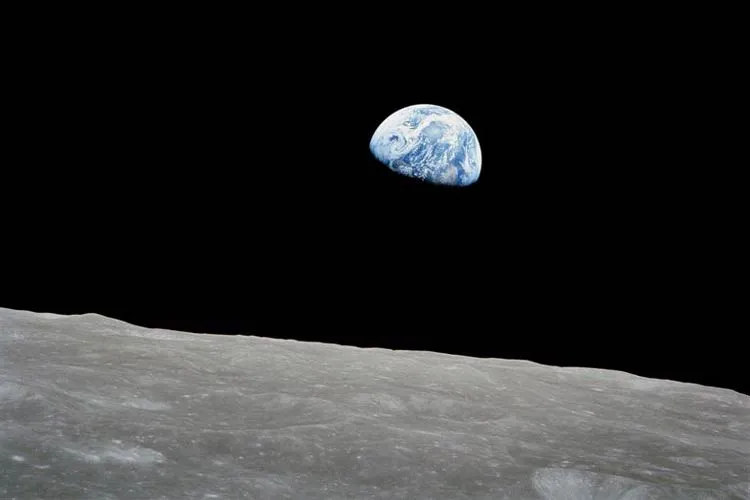
Despite recent advances in mapping the lunar surface to examine the feasibility of building moon cities, a new study has dimmed hopes for permanently colonizing it.
The science-fiction genre has long presented images of human life on the moon. In recent years, alongside accelerating technological progress, space entrepreneurs have also begun planning how such a dream could be realized in practice.
But new research published this week at the Harvard–Smithsonian Center for Astrophysics (CfA) offers a more realistic view and shows that the biggest barrier facing future colonizers is the moon's ice reserves, which are insufficient to support a lunar city.
The study titled “There Is No City on the Moon” examined how much water and energy a large lunar population would need, how long a city of 100,000 or one million people could survive there, and how sustainable maintaining a lunar city would be.
This research follows several lunar reconnaissance missions and analyses earlier this year that mapped the moon’s surface and the locations and quantities of water there with greater precision, once again fueling debate about humanity’s ability to establish a permanent base there.
Scientists have long been aware of water deposits on the moon, and the latest analyses confirm that these deposits are located in permanently shadowed craters-deep depressions that never receive sunlight.
At temperatures fluctuating between minus 163 and minus 246 degrees Celsius, only about one millimeter of these ices is lost every billion years.
Martin Elvis, senior astrophysicist at the CfA and lead author of the study, explains that in this research “city” was defined as a settlement with a population of one million people and that the average water use per person was assumed to be 500 tonnes.
With these figures, a city of that size would face a complete water shortage within a few years unless it relied on water recycling-but even that would not entirely solve the problem.
The International Space Station (ISS) currently recycles about 98 percent of its water.
According to Elvis’s calculations, if one billion tonnes of lunar water were recycled with the same efficiency as the ISS, a lunar city of one million people could be sustained for about 100 years.
For a lunar city to last longer, its population would likely need to be limited to roughly one thousand people; in other words it would be more of a village on the moon than a city.
However, if a lunar city could recycle 99.9 percent of its water, a population of one million could theoretically live sustainably for about two thousand years. This situation could be enhanced with other water-efficiency methods such as vertical farming or by importing water.
Energy, however, would not be problematic for a lunar city, because it can be supplied using abundant solar energy. Around the lunar poles there are areas known as High Illumination Regions where the sun never fully sets and remains close to the horizon.
The rims of these craters are higher than the surrounding plains, making them suitable sites for installing photovoltaic equipment that can continuously capture solar energy.
According to the study, towers one kilometer high covered with solar panels and installed on crater rims could each generate about 3 gigawatts of power-enough not only for residential facilities but also for industrial units.
Moreover, one of the primary raw materials for solar cells, silicon, makes up about 20 percent of the moon’s surface, meaning part of the manufacturing process for these cells could be carried out on the moon itself-an option some companies plan to exploit.
Japanese construction firm Shimizu announced earlier this year plans to install solar panels along the lunar equator to generate 13,000 terawatts of power-more than the total electricity consumption of Earth.
The moon’s very thin atmosphere means solar power generation is not affected by weather conditions, providing the advantage of a stable energy output.
So although a lunar city with a population of one million still seems out of reach, the start of serious lunar colonization may not be far off.
Additionally, although current exploration technologies can only probe a few meters below the lunar surface, larger ice deposits may be discovered at greater depths in the future.
Martin Elvis expressed hope that “this paper will serve as a spur for all stakeholders involved in lunar exploration to begin a serious discussion about the overall sustainability of the moon and, in particular, long-term management of its water resources.”